
9 Thanksgiving Activities for Preschoolers Without Worksheets
Thanksgiving learning does not need to look like a packet of tracing pages. Preschoolers can practice shapes, patterns, counting, sequencing, comparing, sorting, and one meaningful idea through real objects and projects that move across the table or floor.
A worksheet can be useful sometimes, but it is not the only way to give a preschooler structure. A turkey tail can become a pattern. Plastic plates and cups can become a counting job. Broad paper leaves can become a same-and-different comparison. A short picture story can be arranged in order without a printed answer sheet or fill-in boxes.
These Thanksgiving activities stay hands-on and worksheet-free. They use household objects, broad paper pieces, blank scrap paper, and simple child-made drawings. There are no tracing rows, academic answer sheets, printed completion boxes, pre-made study-card systems, or visible numerals required. Any paper cues are homemade and secondary to the real activity. Keep the work playful, accept imperfect answers, and stop when the project starts feeling like a test.
Put the learning into the objects
A craft can still include shapes, counting, patterns, sequencing, or same-and-different comparison, but it does not need to look like a printed academic sheet. Let the child move real pieces, build something, or arrange the idea themselves.
1. Loose Turkey Tail Patterns
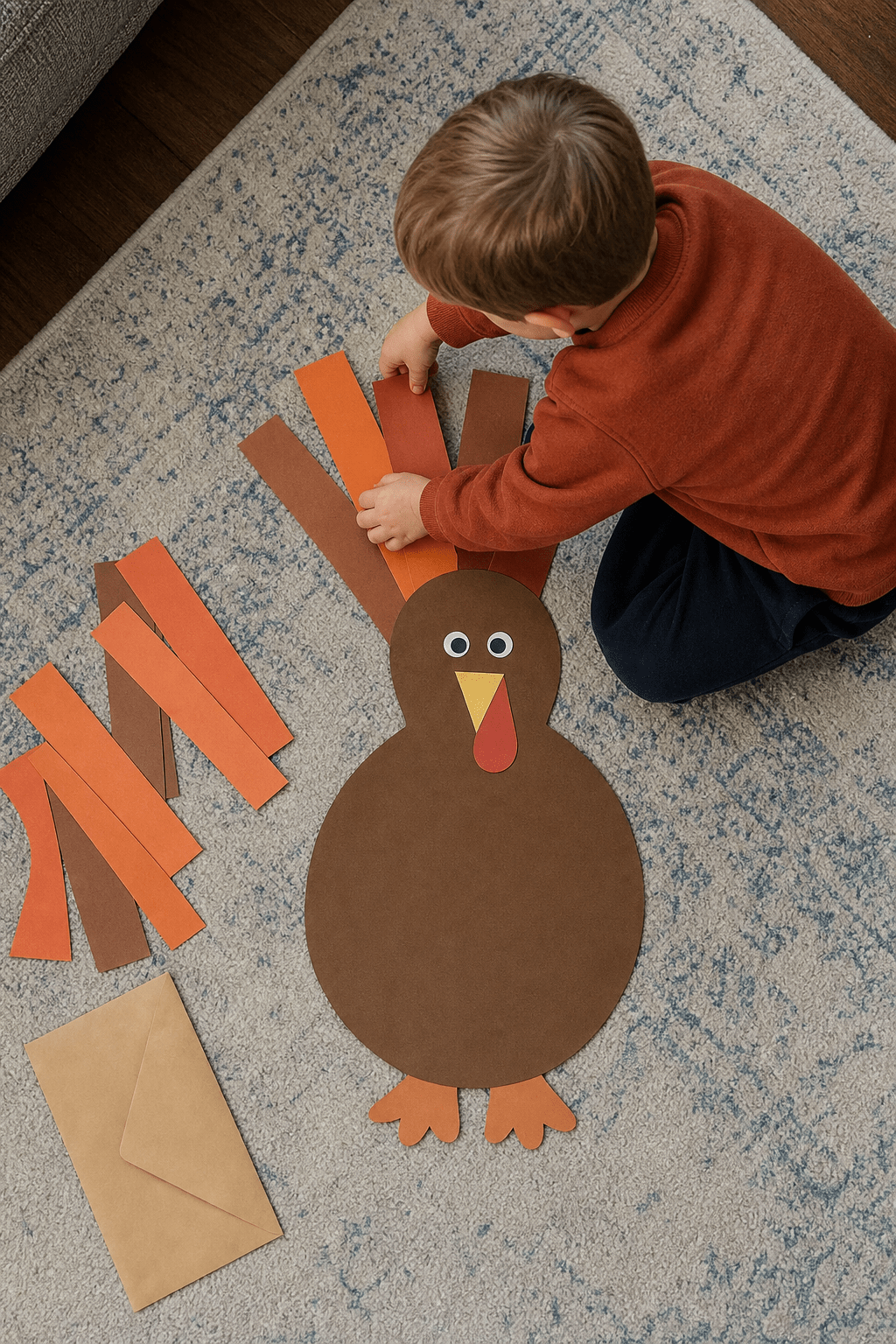
Place a large paper turkey body on the floor and offer broad paper strips in two colors. Your preschooler builds a simple repeating tail behind the turkey, such as orange, brown, orange, brown. Then they pull the strips away and create a different pattern. Keep the paper pieces loose so there is no worksheet to complete and no right answer permanently attached to the page. If patterning is too hard, copy one short sequence together. Store the broad strips in one envelope when finished. Do not use tiny feathers, printed pattern cards, or numbered spaces.
Why it works: Moving loose pieces lets children practice patterning through a real build rather than filling a printed row.
Age range tweak:
- Age 3: Copy a two-color pattern with four broad strips.
- Age 4: Build and rebuild a simple repeating pattern.
- Age 5: Invent a longer pattern, explain the rule, change one piece, and repair the sequence.
2. Real Table Count-and-Check
At a low table, seat your preschooler on a chair and set out three empty plastic plates, three empty plastic cups, and three cloth napkins. Ask them to make one complete set at a time until the materials are used. Then mix the pieces and rebuild the settings in a different order. Count aloud together if that feels natural, but there is no printed number line, answer box, or worksheet. Keep every item empty, cool, and unbreakable, and do this away from hot food, knives, glass, and the actual serving path.
Why it works: The child sees quantity through real objects and checks the work by noticing whether each setting has the same pieces.
Age range tweak:
- Age 3: Make two simple settings together using plate and napkin.
- Age 4: Make three complete settings and check what each one needs.
- Age 5: Plan the quantity, build all settings, find any missing piece, and pack the materials afterward.
When You Need More Screen-Free Ideas

We made a free Screen-Free Activity Finder for exactly this. Pick your child's age, how much time you have, how much energy they have, and how much help you can give. It'll send you screen-free activity ideas that use normal home materials.
Drop your email and we'll send it over. Unsubscribe anytime.
3. Pumpkin Shape Build
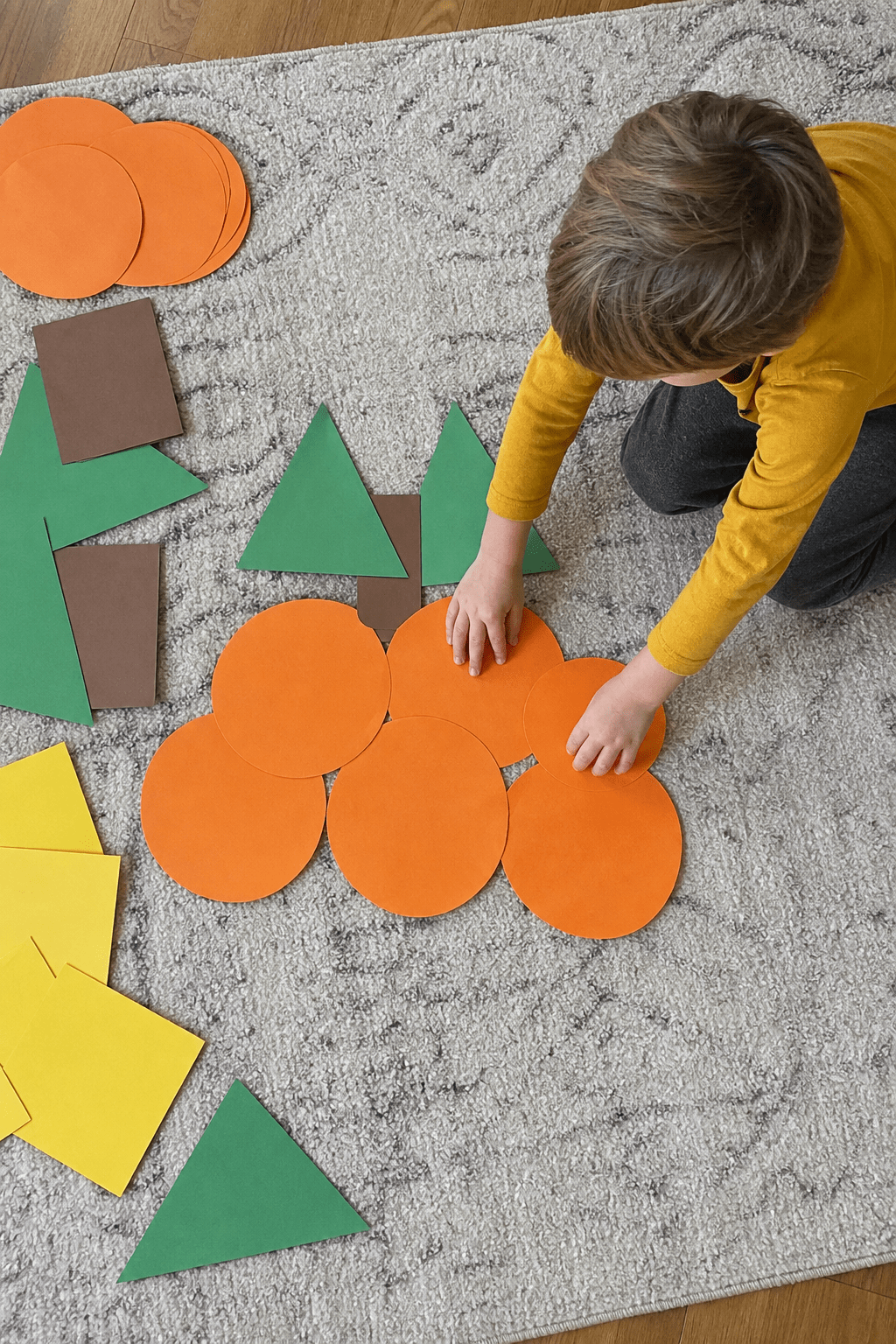
Adult-cut several large paper circles, ovals, rectangles, and triangles in fall colors and place them on a rug. Your preschooler chooses shapes to build a pumpkin, turkey, plate, house, or completely new Thanksgiving picture. The pieces stay loose so they can be moved and rebuilt. You can name a shape when it comes up naturally, but there is no shape-matching page or printed outline to fill. Keep all pieces broad and remove any torn scraps immediately. When the first picture is done, take a quick photo if you want, then mix the pieces and build something else.
Why it works: Loose large shapes give preschoolers shape practice through construction, choice, and rebuilding instead of a printed matching task.
Age range tweak:
- Age 3: Use three or four large shapes and build one simple picture together.
- Age 4: Choose from several broad shapes and rebuild the picture once.
- Age 5: Plan a picture, explain which shapes are being used, rebuild it a different way, and sort the pieces afterward.
4. Thanksgiving Story Object Sequence
Choose four real safe objects that can tell a simple Thanksgiving-day story, such as a folded napkin, empty plastic cup, board book, and soft stuffed animal. Place them in a basket and tell a short sequence: set the napkin, place the cup, look at the book, tuck the animal in. Your preschooler repeats the order with the objects, mixes them, and creates a new story sequence. There are no printed sequencing strips or answer boxes. Keep the objects large, familiar, and nonbreakable, and let the child's invented order count as a valid new story.
Why it works: Real objects turn sequencing into action and storytelling rather than a worksheet where the child has to choose a correct printed answer.
Age range tweak:
- Age 3: Use two objects and act out a simple first-then sequence.
- Age 4: Use three or four objects and rebuild one short story order.
- Age 5: Invent a new sequence, explain the story, change one step, and reset the basket.
5. Same-and-Different Leaf Pairs
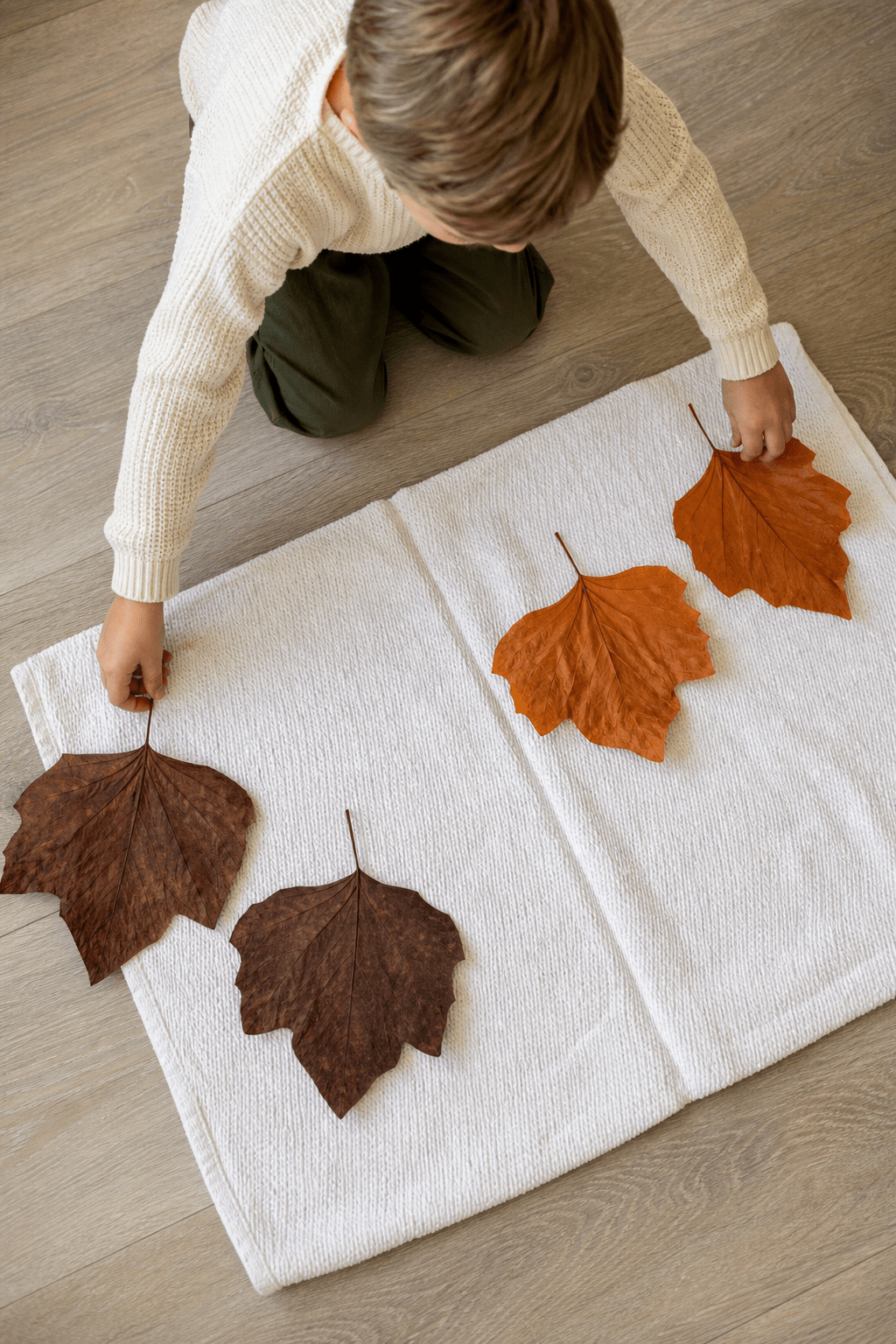
Use four large adult-cut paper leaves or four large intact outdoor leaves that have been inspected and brought inside. Make two obvious pairs, such as two orange leaves and two brown leaves, or two large and two small. Put the pieces on a towel and ask your preschooler which two seem the same and which pair looks different. Then mix them and make a new pairing rule. There is no printed chart or marking boxes. Keep all leaves broad and intact, and skip brittle natural pieces that can break into fragments.
Why it works: Comparing real or broad paper leaves lets the child see and explain differences without circling answers on a page.
Age range tweak:
- Age 3: Use one obvious matching pair and name the shared feature together.
- Age 4: Use two pairs and let them match by one visible feature.
- Age 5: Create a second rule, explain why pieces belong together, and return natural leaves or store the paper ones.
6. Napkin Color Pattern Line
Set six folded cloth napkins or washcloths in two colors on a clear rug. Your preschooler lays them in an alternating line, changes one position, then rebuilds the line. If you only have one color, fold half into rectangles and half into squares and pattern by shape instead. The activity uses the real cloth objects, not a pattern worksheet or printed strip. Keep the line short enough that it stays easy to reset. When finished, stack all cloths and return them to the linen basket. For another quick round, rotate the whole line so the child has to rebuild the same rule from the opposite end.
Why it works: The pattern is large, movable, and useful, so preschoolers can practice repetition while handling normal household materials.
Age range tweak:
- Age 3: Use four cloths and copy a simple alternating line.
- Age 4: Build a six-piece pattern and rebuild after mixing.
- Age 5: Create a pattern by color or fold shape, explain the rule, change one piece, and repair it.
7. Harvest Basket Sort

Put six large safe household objects in a basket, using pairs that can be sorted by one simple feature: two plastic cups, two folded washcloths, and two sturdy board books. Your preschooler sorts them into three towel spots, mixes them, then sorts by a new rule such as soft versus hard or orange versus not orange. No printed category cards or answer sheets are needed. Keep the objects large, lightweight, and approved by an adult. Do not include food, batteries, tiny toys, breakables, or anything the child has to climb to reach.
Why it works: The child creates categories from real objects and can change the rule, which makes sorting more flexible than completing a fixed worksheet.
Age range tweak:
- Age 3: Use four large objects and sort into two obvious groups together.
- Age 4: Sort six objects by type, mix, and repeat.
- Age 5: Choose a new sorting rule, explain it, check every object, and return everything to its real home.
8. Pumpkin Size Order
Adult-cut four broad paper pumpkin shapes in clearly different sizes and place them loose on the floor. Your preschooler puts them in order from smallest to largest, reverses the order, then mixes them and tries again. Let them overlap pieces to compare rather than pointing to printed size words or numbers. If they want to draw, place the largest pumpkin on blank paper and trace around it once as part of the project, not as a tracing row. Store all four broad shapes in a plain envelope when finished. A second round can start by hiding one size behind the envelope and asking where it belongs when it comes back.
Why it works: Loose size pieces make ordering visible and physical without turning the idea into a printed size worksheet.
Age range tweak:
- Age 3: Use two clearly different sizes and compare bigger and smaller.
- Age 4: Order three or four pumpkins and reverse the line.
- Age 5: Predict the order, compare by overlapping, reverse it, and store the broad shapes.
9. Dinner Picture Build
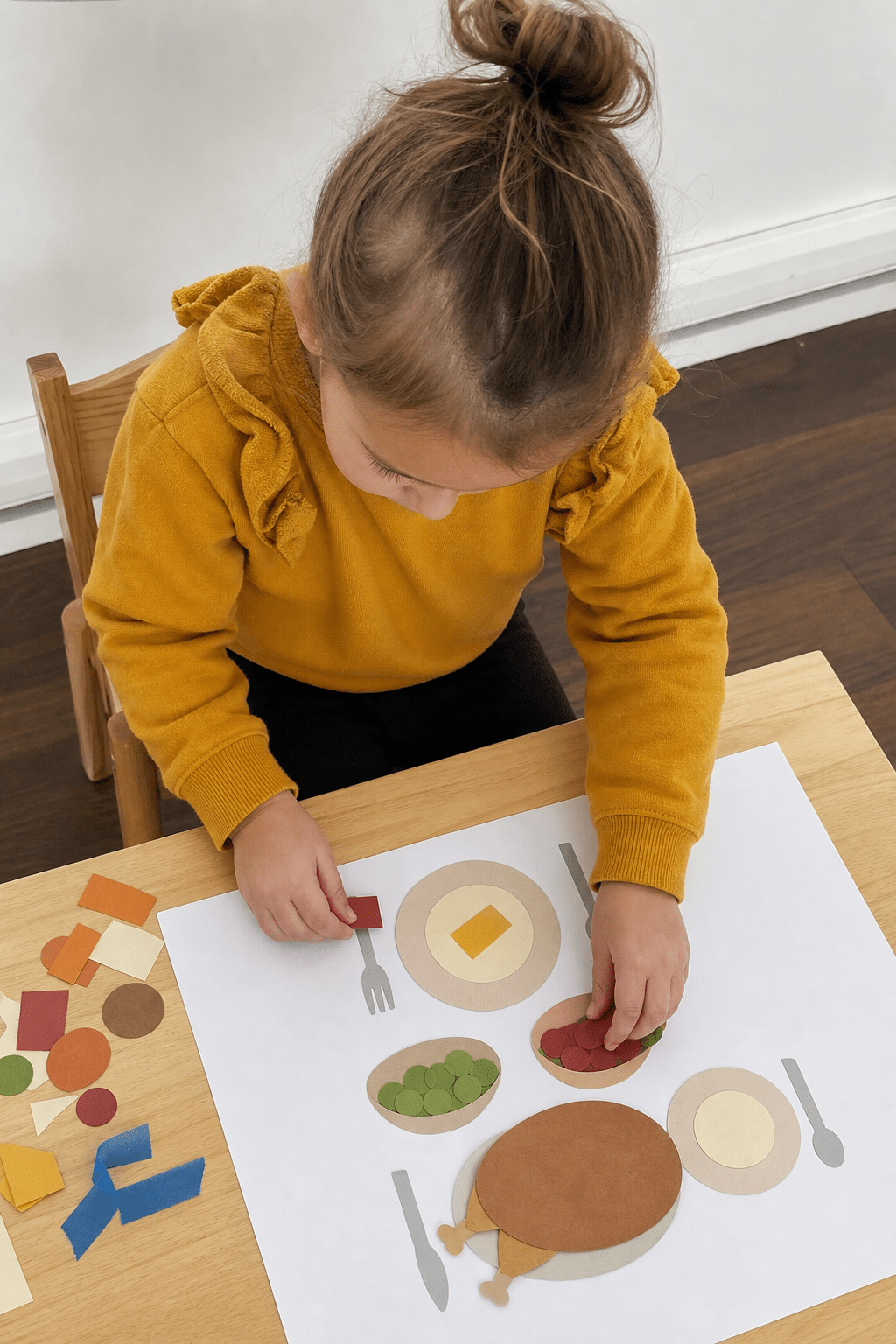
Give your preschooler a blank sheet of paper and several large adult-cut paper shapes at a low table, with the child sitting on a chair. Use circles for plates, rectangles for napkins, and simple broad shapes for cups or food. The child arranges the pieces to build a Thanksgiving dinner picture, moves them until the layout feels right, then secures only a few with short painter's tape if they want to save it. There is no printed scene to complete, no fill-in boxes, and no right answer. Keep the paper pieces broad and collect loose tape immediately.
Why it works: Building a scene from loose shapes combines spatial planning, shapes, and storytelling without requiring a worksheet-style finished answer.
Age range tweak:
- Age 3: Use three broad shapes and build one simple plate-and-napkin picture together.
- Age 4: Arrange several pieces, move them, and choose a finished layout.
- Age 5: Plan a fuller scene, explain the arrangement, change one part, and decide whether to tape or reset the pieces.
The Bottom Line
Preschool learning can stay hands-on. Patterns are easier to understand when the child can move the pieces. Counting feels different when they are setting real cups. Sequencing becomes a story when they act it out with familiar objects.
The goal is not to ban worksheets forever. It is to remember that a preschooler can practice the same thinking through building, sorting, comparing, arranging, and pretending.
For Thanksgiving, the holiday already gives you plenty of real objects and useful jobs to work with.

Want to have these ideas in one place, customized for your kid in just a click? Grab our free Screen-Free Activity Finder.
One mom told us: "My kid was about to have a full meltdown and I had nothing. Pulled up the Screen Free Activity Generator and it gave me 'Tupperware Tower Challenge.' I dumped every plastic container from my kitchen on the floor and told her to stack them. She went from tears to totally absorbed in about 30 seconds. Spent 25 minutes stacking, crashing, matching lids. I just sat there drinking my coffee. Sometimes the simplest stuff works the best."
The Screen-Free Activity Finder is free. Put your email in below and we'll send it over.